
Garage Door SEO Checklist: Service Pages, Service Areas, and FAQs
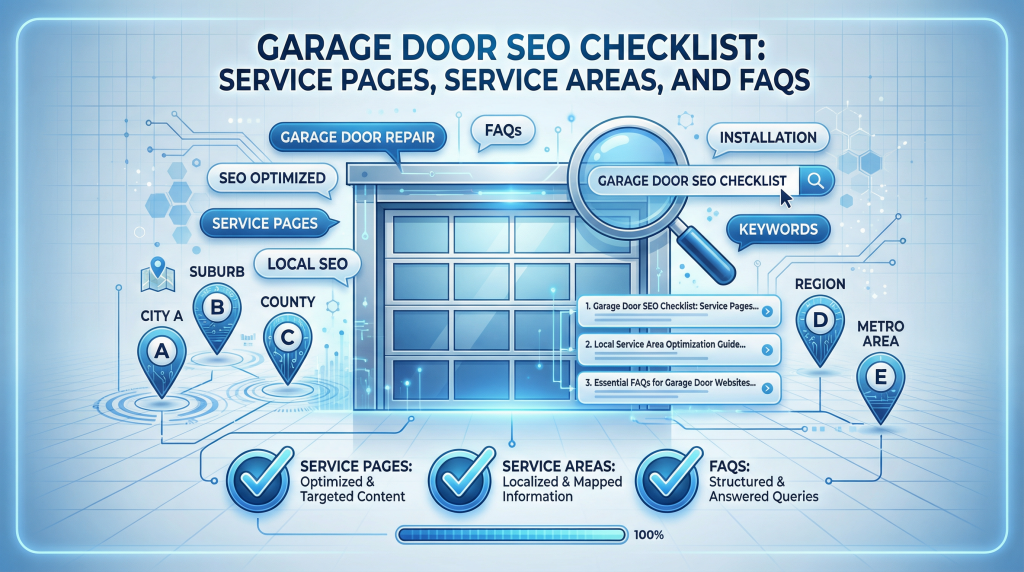
Garage door SEO and GEO (Generative Engine Optimization) has a mix of different factors; one of the bigger factors for both is your website. Missing the right pages, repeating the same location content 40 times, or skipping the trust signals that make Google Maps, LLMs, and real humans choose them can result in revenue loss. Sure, you can beat the streets with flyers, yard signs, and video commercials, but if you don’t have a site that can take the traffic from those searching your name and services, you are leaving money on the table. Here is a guide to creating a garage door company site that has the best chance of ranking and converting.
TLDR:
- Build 6–10 core service pages that match what homeowners search when something breaks: springs, openers, off-track, installation, and a few more.
- Add a Service Areas hub plus a controlled set of city pages (only the places you truly serve), and make each page meaningfully unique.
- Use service-in-city pages only where competition is tough, and only for your top services and top cities.
- Put 8–12 FAQs on every money page to capture “People also ask” intent and remove hesitation before the call.
- Avoid “doorway page” footprints: thin, copy-paste location pages that funnel to the same destination. Google may ignore them or treat them as spam.
Why These Three Page Types Win in 2026
Ranking in Google and Google Maps isn’t about one magic trick. It’s about being the most relevant, the most trustworthy, and the easiest to choose. Getting into LLM traffic means the LLMs need to understand your business as a whole (what’s known as an entity). That means service pages build topical authority, service area pages prove local relevance, and FAQs match how people actually search and help them feel comfortable calling. When those three work together, your site and your Google Business Profile support each other. Together, that helps build an entity. The stronger your entity signals are, the more chances you show up more often, and you get called more often.
The Core Strategy: Build the Right Page Mix First
Before you obsess over backlinks, tools, or a new theme, get the foundation right. Most garage door companies don’t have a traffic problem. They have a structural problem.
Here’s the page mix that gives you the best chance to rank
Service Pages: Your “Money Pages” (6–10 Must-Haves)
These are the pages that should bring leads every week. They are also the pages you should link to from your Google Business Profile, your GBP posts, and your service area pages.
The Service Pages Every Garage Door Company Should Have
Start with these:
- Garage Door Repair
- Garage Door Spring Repair / Replacement
- Garage Door Opener Repair
- Garage Door Opener Installation / Replacement
- Garage Door Installation (New Doors)
- Off-Track Garage Door Repair
- Garage Door Cable Repair
- Garage Door Roller / Hinge Repair (optional, but strong)
- Commercial Garage Door Repair (only if you actually do it)
If you only build one page called “Services,” you’re making Google guess. Make it easy.
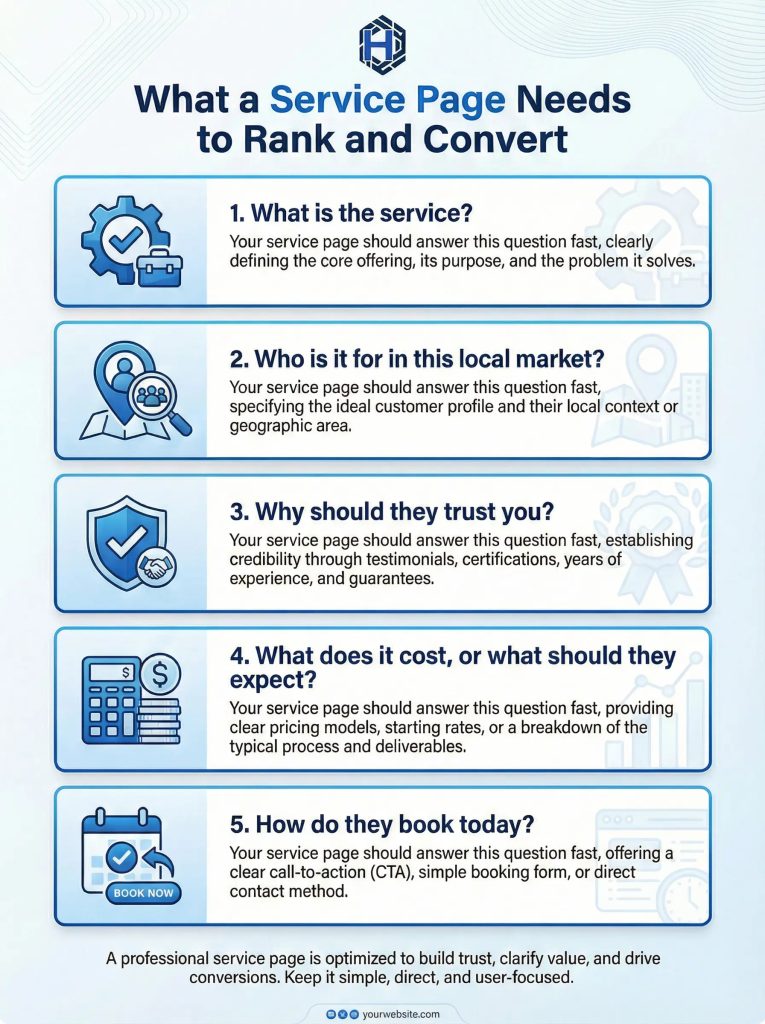
What a Service Page Needs to Rank and Convert
Your service page should answer five questions fast:
- What is the service?
- Who is it for in this local market?
- Why should they trust you?
- What does it cost, or what should they expect?
- How do they book today?
A clean service page layout that works:
- H1: Broken Garage Door Spring Replacement in [City]
- Short subheader: Same-day service • Licensed & insured • Warranty options
- CTA row: Call Now + Request Service
- Trust block: Review snippets + badges (insured, warranty, years in business)
- Service details: What causes the issue, what your tech checks, what you replace
- Pricing expectations: “Most spring replacements fall within ___ to ___ depending on door size and spring type.”
- Process: What happens when you call, the arrival window, and an upfront quote before work begins
- FAQs: 8–12 questions that match real searches
- Final CTA: One last clear next step
Short forms win here. Name, phone, zip code, and “what’s going on” is enough.
Internal Links That Help More Than You Think
Link these pages to each other on purpose.
- Spring page links to cable repair and off-track repair (they’re related problems).
- Opener repair links to opener replacement (some repairs turn into replacements).
- The installation page links to insulated doors, carriage-style doors, or your brand pages if you carry them.
This builds topical coverage without writing 200 blog posts. It also keeps people on your site longer, which helps conversion and engagement.
Service Area Pages: The Safe Way to Target Cities and Neighborhoods
Service area pages can be a goldmine. They can also become dead weight if they look like copy-paste doorway pages.
Step 1: Create a Service Areas Hub Page
Build a page like:
- /service-areas/
This page should:
- List the cities/neighborhoods you actually serve
- Link to each city page
- Explain how your service area works (“based near ___, we serve a ___ mile radius”)
- Include a short CTA and your phone number
This hub makes the rest of your location pages look intentional, not spammy. It also helps Google crawl everything.
Step 2: Build a Controlled Set of City Pages (Not 100)
If you serve Houston, don’t publish 85 thin pages for every suburb in existence. Start with the places that produce real work. A smart starting set is 5–10 city pages. A larger multi-truck company might run 10–20.
Your city page slugs can look like:
- /service-areas/cypress-tx/
- /service-areas/katy-tx/
- /service-areas/spring-tx/
Now, the most important part.
How to Make City Pages Unique (So They Rank)
A good city page is not just “We provide garage door repair in [City].” That’s not helpful to anyone. Here are the elements that make a city page real:
- A short intro that mentions the city naturally
- The top 3 services people call you for in that area
- A “common issues in this area” section
- 2–4 reviews from customers in or near that city
- Job photos taken in that area over time
- Neighborhood mentions that make sense
- Links to your main service pages
A “recent jobs in this area” module works well:
- “Replaced a snapped torsion spring on a two-car steel door near ____.”
- “Installed a quiet belt-drive opener for a homeowner off ____.”
- “Reset an off-track door after a roller failure near ____.”
You don’t need to write a novel. You need to prove you actually work there.
Avoid the Doorway Trap
Doorway pages are location pages that exist only to funnel traffic to the same place. If your city pages are nearly identical and all push people to one generic “Garage Door Repair” page, you’re creating a pattern Google tends to ignore.
A simple rule: aim for 40–60% of the page content to be location-specific. If you can’t do that, don’t publish that page yet.
Service-in-City Pages: Use Them Like a Scalpel, Not a Chainsaw
These are pages like:
- /cypress/garage-door-spring-repair/
- /katy/garage-door-opener-repair/
They’re powerful in competitive metros. They’re also the fastest way to build a spam footprint if you scale them mindlessly.
When Service-in-City Pages Make Sense
Use them when:
- You’re in a big market with heavy competition
- Your core service pages rank okay, but you can’t break into the top spots
- You have enough proof (reviews, photos, jobs) to make them unique
How Many Should You Build?
Start with:
- Your top 2–5 services
- Your top 3–10 cities
That’s 6 to 50 pages, depending on scale. Most companies should start closer to 6–15 and earn the right to expand.
What These Pages Need to Avoid Being Thin
They should include:
- The full service-page structure
- City-specific job proof and photos
- Localized FAQs
- Links up to the city page and laterally to other services in that city
If a service-in-city page is just your service page with the city swapped, skip it. Google will treat it like filler.
FAQs: The Ranking and Conversion Booster Most Companies Underuse
FAQ sections do two jobs at once. They bring in long-tail searches, and they help people feel confident enough to call. You don’t need FAQs because you want “rich results.” You need FAQs because homeowners ask the same questions every day.
Where FAQs Belong
Put FAQs on:
- Every core service page (8–12 questions)
- Every service-in-city page (5–8 questions)
- Optionally, a master FAQ page (useful, but not required)
FAQ Topics That Perform Well for Garage Doors
These are the buckets of information that tend to convert:
Pricing and estimates
- “How much does spring replacement cost in [City]?”
- “Do you charge a service call fee?”
Safety and urgency
- “Can I open my garage door with a broken spring?”
- “Is an off-track door dangerous?”
Time and logistics
- “How long does a spring replacement take?”
- “Do you offer same-day service?”
Parts and quality
- “Do you replace one spring or both?”
- “Do you use high-cycle springs?”
- “Do you repair LiftMaster openers?”
Warranty and trust
- “Do your repairs come with a warranty?”
- “Are you licensed and insured?”
Write the answers like you’re talking to a homeowner on the phone. Use short sentences and clear answers with no fluff.
Bonus: GBP Q&A Matters Too
People also ask questions directly on your Google Business Profile. Seed a few common questions and answer them from the business account.
Keep them simple:
- “Do you offer emergency service?”
- “Do you replace torsion and extension springs?”
- “How quickly can you arrive?”
This reduces friction before the call. It also makes your listing look active and cared for.
The Checklist: “Best Chance to Rank” Setup
If you want a single checklist to follow, this is it.
Core Website Pages
- 6–10 service pages built and internally linked
- Each service page has: CTA above fold, trust block, pricing expectations, FAQs
- Fast mobile load, click-to-call, clean URLs, SSL
- LocalBusiness schema and consistent NAP
Location Architecture
- Service Areas hub page
- 5–20 city pages that are truly unique and navigable
- No thin pages created just to target keywords
- Each city page includes proof: local reviews, photos, job mentions
Competitive Expansion
- Service-in-city pages only for top services × top cities
- Each has city-specific proof and localized FAQs
- Links up to city pages and across related services
FAQ System
- 8–12 FAQs on each service page
- 5–8 localized FAQs on each service-in-city page
- Optional master FAQ page
- GBP Q&A seeded and maintained
Common Mistakes That Hold Garage Door SEO Back
- Publishing 50 city pages with the same content and swapping the city name
- Trying to rank service pages without any trust signals or reviews
- Burying the phone number and making forms too long
- Skipping internal linking, so Google can’t see your topical structure
- Treating FAQs like an afterthought instead of a conversion tool
These mistakes don’t look dramatic. They quietly block growth.
Closing: Build the Structure, Then Let It Compound
The right website structure and content can set your garage door company up to win in SEO and GEO. Of course, there are other factors in both besides your website, but you want your visitors to know and understand who you are, what services you provide, and where you provide them. Consequently, so does Google, Google AI Overview, Google Maps, and more. Follow this structure and give Google and the LLMs the best chance to understand and recommend your company.
If your garage door company is stuck not understanding what has gone wrong with your SEO or website, Hughbanks Design offers a free review session to help you understand where you’re stuck. Contact us today if this is you because you don’t want to leave money to competitors.
Engine #2: Google Business Profile That Wins the Map Pack
Your GBP can be your best salesperson. It works nights and weekends.
GBP Foundations That Impact Rankings
Start with the basics:
- Correct primary category (garage door supplier)
- Accurate service areas
- Hours that reflect reality (and let you compete for “open now” searches)
- Services filled out inside GBP (not just on your website)
- Business description that mentions your core services and your area
Then do what most companies won’t do. Run GBP like a weekly routine.
The Weekly GBP Routine Most Competitors Skip
Every week:
- Publish 1 GBP post
- Add 3–8 new photos
- Reply to every new review
- Check Q&A for new questions
Here are GBP post formats that work:
- “Before/After: Door off-track repair in [City]” with photos
- “Winter reminder: Cold weather can stress springs and rollers”
- “$X off opener replacement this month” (if you can honor it)
Simple works. Consistency works more.
Reviews: The Unfair Advantage
Reviews move everything:
- Map pack visibility
- LSA ranking
- Conversion rates on calls
You need a review routine that runs on autopilot. Here’s a clean system:
Text sent 30–60 minutes after the job:
“Thanks for having us out today. If we earned it, would you leave a quick Google review? It helps local homeowners find a reliable garage door company. [Review Link]”
Follow-up the next day (only if they didn’t review):
“Quick follow-up: here’s the review link again in case you missed it yesterday. Appreciate you. [Review Link]”
And respond to reviews like a human:
- Use their first name if shown
- Mention the service (“spring replacement,” “opener repair”)
- Thank them, then move on
That’s it. No essays.
Engine #3: Local Services Ads That Produce Daily Calls
LSA is where many garage door companies get predictable lead flow. But it rewards responsiveness more than a clever setup.
LSA Setup Checklist
- Complete verification (license/insurance/background check)
- Match your profile info to your GBP (name, phone, areas)
- Select all relevant job types (springs, openers, installs, off-track)
- Set service area tightly enough to be relevant, wide enough to fill the schedule
- Turn on message leads if you can respond quickly
What Actually Makes You Rank Higher in LSA
Four things matter most:
- Review strength
- Rating
- Responsiveness (calls answered, messages replied)
- Business hours and availability
If you miss calls, LSA performance drops. It’s that direct.
A real-world situation: Two companies have similar reviews, but one answers within 15 seconds, and the other hits voicemail half the time. Google will favor the first one because it creates a better user experience.
So build a “never miss a call” system:
- Office phone + owner’s cell as backup
- After-hours answering service if needed
- Fast callback rules: call back within 3 minutes, not “later”
Budget Guidance and Expectations
Costs vary by market. Start with what you can handle operationally.
A practical approach:
- Set a budget that targets 1–3 leads per day
- Track close rate and revenue per job
- Increase the budget only when you can prove ROI and handle volume
If LSA volume caps out, add PPC to catch more searches. LSA isn’t always enough by itself in competitive metros.
Tracking and Follow-Up: The Hidden Lever Behind Consistent Leads
Marketing is only half the fight. Speed-to-lead is the other half.
What to Track (Without Making It Complicated)
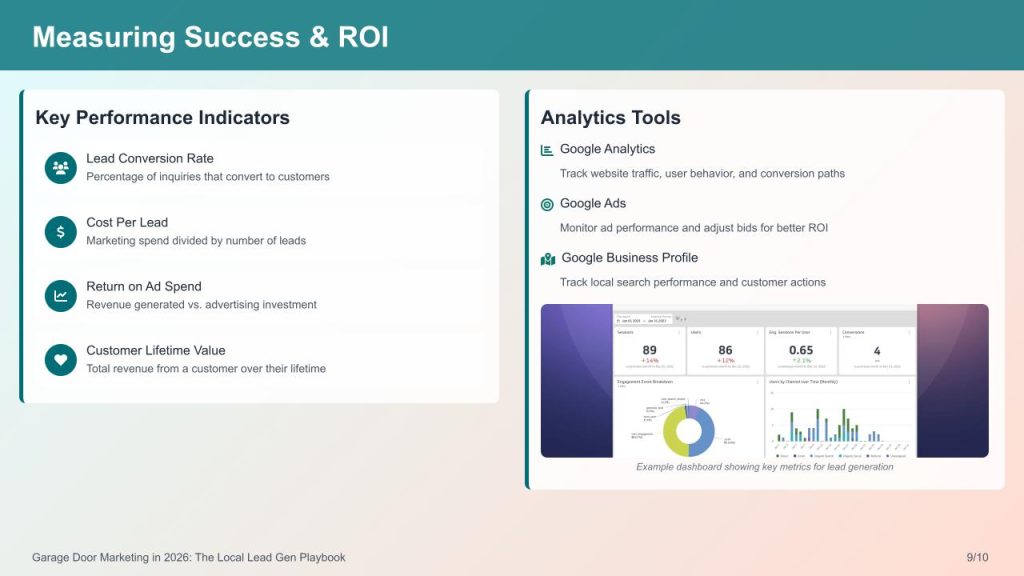
In GA4:
- Contact form submissions (thank-you page or event)
- Click-to-call taps on mobile
With call tracking (CallRail or similar):
- Different numbers for website vs ads (and optionally GBP)
- Call recordings for quality control
- Call duration to filter junk
Then track outcomes:
- Lead → booked job
- Booked job → revenue
- Revenue → profit
When you know those numbers, scaling becomes math. It stops being emotion.
Speed-to-Lead Rules That Win Jobs
- Answer calls fast
- Reply to message leads fast
- Follow up on missed calls immediately
- Text after missed calls:
“Sorry we missed you. Do you need a repair or installation? Reply with your ZIP code, and we’ll get you scheduled.”
This is simple. It works because most competitors are slow.
The 30-Day Quick Action Plan
Here is a quick action guide that can help you build marketing momentum for your garage door company in as little as 30 days.
Week 1: Fix the foundation
- Improve mobile usability and load speed
- Add sticky click-to-call
- Clean up GBP categories, hours, and service areas
- Start the review request routine
Week 2: Build the money pages
- Upgrade your top 3 service pages using the structure above
- Add review snippets and FAQs
- Add internal links between services and service areas
Week 3: Launch or tighten LSA
- Complete verification
- Turn on message leads if you can respond quickly
- Set a budget and define coverage cleanly
- Establish “never miss a call” rules
Week 4: Make it repeatable
- Weekly GBP posting routine
- Weekly photo uploads
- Monthly performance review (GA4 + GSC + LSA)
- Adjust based on lead quality and booking rate
Common Mistakes That Kill Daily Lead Consistency
It is easy to make a mistake here and there in your marketing, and those little mistakes can add up. So here are a few mistakes you can avoid to help you build momentum.
- Thin city pages that say nothing
- Ignoring GBP updates for months
- Missing calls from LSA
- No review routine
- No call tracking, so you can’t see what’s working
- A website that looks untrustworthy on mobile
Final Thoughts: Build a System that Brings Compounding Results
If you want consistent daily leads in 2026, you need to build a system that gets your name in front of the customer and builds trust so they will call you. That means build strong service pages that rank and convert. Run your GBP every week, not just for ranking, but for conversions. Use LSA to capture the highest-intent calls, and respond fast enough to deserve them.
Then track everything and tighten the screws each month. That’s how garage door companies stop living off random spikes and start operating with predictable lead flow. If you need an evaluation on where to start or where your garage door marketing system is broken, contact us for a free evaluation. We have been working with garage door companies since 2019 and understand the unique challenges they face when getting and keeping customers.